
Hyaluronic acid, a natural treatment not only for skin rejuvenation
Presenting Author's Biography
Milos Beran is a head of the Nanotechnology research group of Czech Agrifood Research Center. He has been a principal investigator of many research projects in biotechnology, enzymology, and tissue engineering fields. Currently, he is engaged in applied research and development in the field of advanced materials and technologies. He is an author of 21 granted patents and more than 70 utility models.
Hyaluronic acid, a natural treatment not only for skin rejuvenation
We did not choose the name Hyalogos for our company by chance. The word LOGOS was introduced into philosophy by Heraclitus of Ephesus, who meant by it the common order of the universe, which man only uncovers through thinking. While studying the scientific literature on hyaluronic acid (hereafter HA), I realized how complex "universe" with countless structural, but also metabolic (related to energy and substance conversion) and signaling functions, which science is only beginning to discover, this molecule in our body in reality creates.
HA belongs to a group of substances collectively referred to as mucopolysaccharides (mucous polysaccharides) or glycosaminoglycans (this includes, for example, chondroitin sulfate or heparin), i.e. polysaccharides (long-chain complex sugars) whose structure contains, in addition to simple sugars, also so-called amino sugars (sugars containing amino group). In the case of HA, these basic building blocks (you can think of them as beads on a string of connected long-chain molecules) are glucuronic acid and N-acetylglucosamine. HA is also often found in the form of salts, so-called hyaluronates, with bound sodium or other ions.
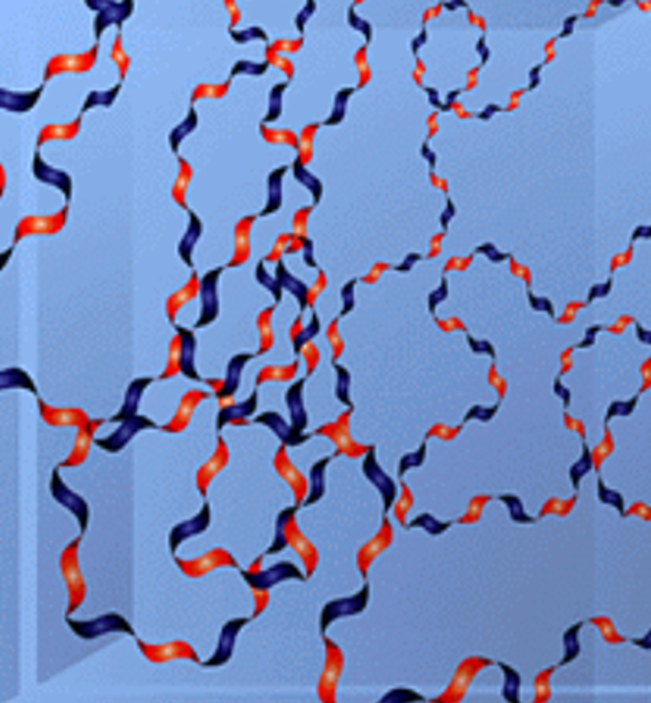
Our body contains approximately 15 g of the HA molecule, which, together with other mucosal polysaccharides, is mainly dispersed in epithelial, connective and nerve tissues. Due to the ability of the HA molecule to bind a large amount of water to form so-called hydrogel, i.e. a thick viscous liquid resembling honey in its physical properties, this ammount represents a volume of at least several hundred milliliters with the bound water. You can imagine it as a large chaotically intertwined cluster of a long linear chain of HA in the form of a double helix, resembling the structure of DNA, which gradually expands and increases in size as it fills with water and thereby increases its volume (see the illustration below).
An image of hyaluronic acid molecule in a hydrogel. The free space is filled with water.
HA was first isolated by Karl Meyer and John Palmer in 1934 from the vitreous of bovine eyes, and its structure was described 20 years later. The first HA fulfilling pharmaceutical requirements was produced in 1979 by a Hungarian physician Balazs, who developed an effective method for extracting and purifying this polymer from rooster combs and human umbilical cords. Balazs's procedure formed the basis for the later industrial production of HA. During the 1990s and the first decade of this century, special attention was paid to the identification and characterization of enzymes involved in HA biosynthesis, as well as the development of bacterial fermentation techniques for the production of HA with controlled molecular size and polydispersity (homogeneity). Currently, HA is already industrially produced by bacterial fermentation. It is not without interest that one of the world's key HA manufacturers, CONTIPRO, is based in Dolní Dobruška in Czech Republic. For several decades, HA was considered only a structural (building) component of so-called extracellular matrix (a substance filling the spaces between the cells of various tissues) of the skin, joints, eyes and a number of other tissues. Thanks to intensive research by many biologists and biochemists, the view of HA has changed dramatically over the past two decades. A very important achievement was, for example, the discovery of existence of special cell receptors for HA on the surface of cells called hyaladherins. Cell receptors are proteins on the surface of the cell or even inside the cell, which have the ability to bind a very specific molecule, called ligand. In the process of specific interaction, different receptors bind different ligands. In a simplified way, we can imagine the receptor as a lock and the ligand as a key. The binding of the ligand to the receptor subsequently triggers some biological response of the cell. The number of types and members of different type groups of the discovered cell receptors for HA is constantly increasing. The functions of some of them have already been described, while the functions of others still await clarification. Today, however, we already know that the binding of certain HA fragments to these receptors activates signaling systems involved in the regulation of processes inside the cell such as cell proliferation, cell differentiation (the formation of specialized types of cells from embryonic or stem cells), cell movement mechanisms and even the process of gradual enzyme decomposition of HA's own molecules. At the whole organism level, HA significantly affects a wide range of biological processes, such as the regeneration of skin and other tissues, wound healing, or immunomodulation and inflammatory processes. Thanks to its ability to regenerate a whole range of our tissues, HA has become one of the key components of countless nutraceutical, cosmetic and nutracosmetic (combining a cosmetic effect with nutritional) commercial preparations. The effectiveness of HA in various forms (i.e. gels, creams, intradermal filler injections, dermal fillers, facial fillers, autologous fat gels, lotion, serum and implants, etc.) in nutritional and cosmetic surface applications against the formation of wrinkles, folds, and other signs of skin aging have been scientifically proven by a number of clinical scientific studies. The rejuvenating effect is achieved by improved skin hydration, stimulation of collagen and elastin, and restoration of facial volume. There is an improvement in the elasticity of the skin, an improvement in the aesthetic score and a smoothing of wrinkles and smaller folds. The aforementioned high water binding capacity of the HA molecule makes the skin softer, smoother and more radiant. However, we must not forget the regenerative and nutritional properties of this substance.
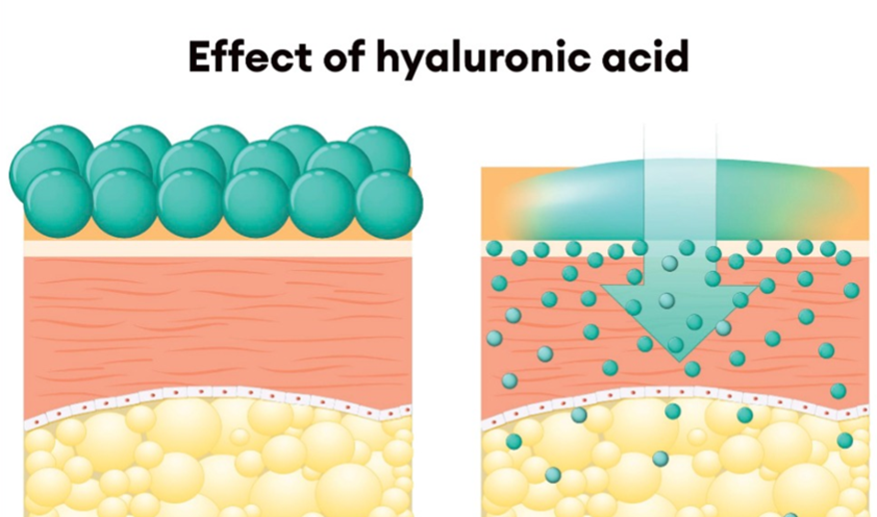
High molecular weight HA primarily forms a film on the surface of the skin (left), while low molecular weight HA penetrates more into the inner layers of the skin and thus contributes to its nutrition.
The discovery of the unexpected complex biological roles of HA has created a new research impulse for biologists and clinical interest in several areas of medicine, such as ophthalmology, joint pathology, skin maintenance and remodeling, tissue engineering of various tissue types, or cancer therapy. HA is quickly renewed in the body, its half-life varies from 12-24 hours in the skin to a few minutes in the bloodstream. The great potential of HA in medicine has stimulated the interest of pharmaceutical companies, which can use new technologies to produce HA and several new derivatives with the aim of increasing both the residence time in various human tissues and anti-inflammatory and other beneficial effects.
HA is non-toxic and non-irritating and can be used for all skin types without the risk of an allergic reaction. The safety of HA is not questioned by any official authorities. Small chemical modifications and crosslinking of HA molecules (see the image bellow for explanation) made it possible to produce water-insoluble products from this molecule, which found a wide application field, especially in medicine in the form of membranes, gauzes, non-woven fabrics, nanofibrous structures, gels, or tubes. These biomaterials are used to cover wounds and burns, or in various areas of so-called tissue engineering of skin, cartilage, bone, blood vessels or fat tissue. HA also supports the process of new blood vessel formation in the body.
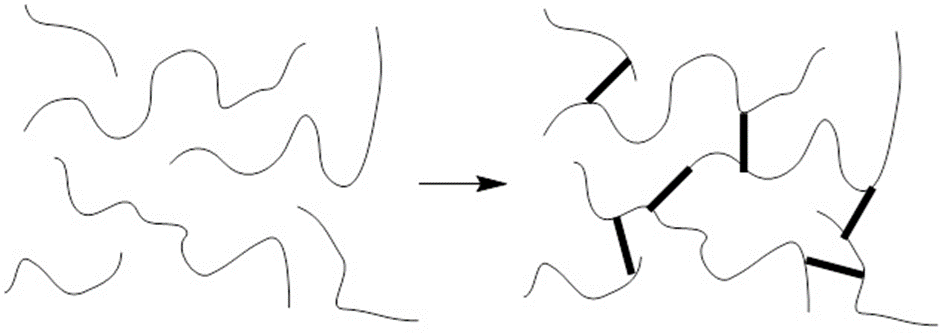
Crosslinking of polymeric chains
HA is contained in articular cartilage and forms the basic component of the so-called synovial fluid. Synovial fluid performs the function of "joint lubricant", which is involved in the smooth movement of the joint. At the same time, it also acts as a shock absorber, as it distributes the pressure acting on the joint surfaces. The unique rheological properties of the synovial fluid gradually deteriorate in the case of osteoarthritis due to a reduction in the size of HA molecules and a simultaneous decrease in the viscosity of the solution, which leads to a decrease in volume, a deterioration of the lubricating effect and cartilage degradation. The painful manifestations of osteoarthritis are very well known to the majority of the aging population. Since the 80s of the 20th century, many preparations for injection into joints have been developed to restore synovial fluid homeostasis and to protect articular cartilage from mechanical damage. Correct joint nutrition certainly also plays its role here, to which food supplements with HA can also contribute.
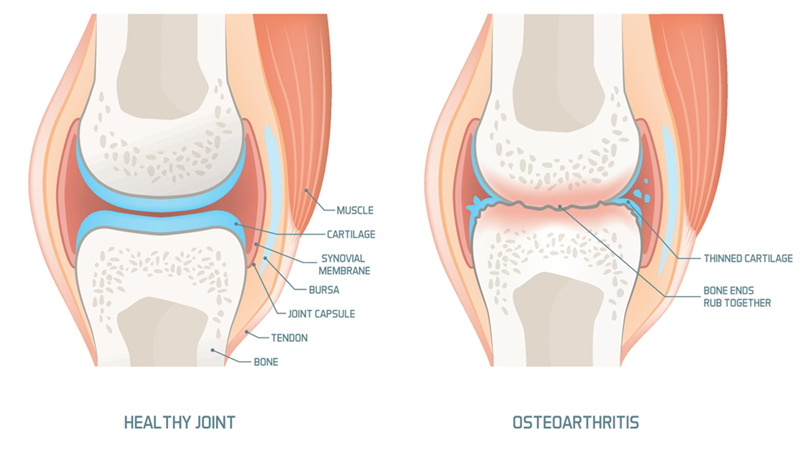
Comparison of healthy and diseased joints
Thanks to their viscoelastic properties, aqueous solutions of HA are widely used as lubricating eye drops and to protect the corneal surface from drying out in the treatment of dry eye syndrome, lubrication of eye lenses or as a carrier of ophthalmic drugs, such as antibiotics and anti-inflammatory agents, to prolong their stay in the eye and subsequently their active effect.
The balance between HA biosynthesis and biodegradation plays a key regulatory function in the human body, as it determines not only the quantity but also the size of HA molecules. Molecular weight and circumstances of bioisynthesis/biodegradation are key factors defining the biological action of HA. High and low molecular weight HA may even exhibit opposite effects and, when present simultaneously in a specific tissue, may produce effects different from the simple sum of the effects of the individual molecules. For example, low-molecular HA can have pro-inflammatory effects in the body under certain circumstances, while high-molecular HA, on the contrary, has anti-inflammatory effects.
HA is sold as a dietary supplement in the US, Canada, Europe and Asia (mainly South Korea and Japan) with some differences in therapeutic focus and marketing, primarily for the joint pain treatment in the US and Europe, and to improve skin condition in Japan or South Korea. The improvement in the skin and joint conditions with daily HA intake has been confirmed in a number of published studies. There is no official and universal instruction on the recommended oral use of HA. Some of the distributors and manufacturers recommend daily dose is 200 mg, while others up to 1000 mg. In the published scientific studies, the daily intake of HA did not exceed 240 mg of HA, which was sufficient to demonstrate the declared effects.
Sources
Abatangelo G, Vindigni V, Avruscio G, Pandis L, Brun P. Hyaluronic Acid: Redefining Its Role. Cells. 2020 Jul 21;9(7):1743. doi: 10.3390/cells9071743.
BuHAari SNA, Roswandi NL, Waqas M, Habib H, Hussain F, HAan S, Sohail M, Ramli NA, Thu HE, Hussain Z. Hyaluronic acid, a promising skin rejuvenating biomedicine: A review of recent updates and pre-clinical and clinical investigations on cosmetic and nutricosmetic effects. Int J Biol Macromol. 2018 Dec;120(Pt B):1682-1695. doi: 10.1016/j.ijbiomac.2018.09.188.
Fallacara A, Baldini E, Manfredini S, Vertuani S. Hyaluronic Acid in the Third Millennium. Polymers (Basel). 2018 Jun 25;10(7):701. doi: 10.3390/polym10